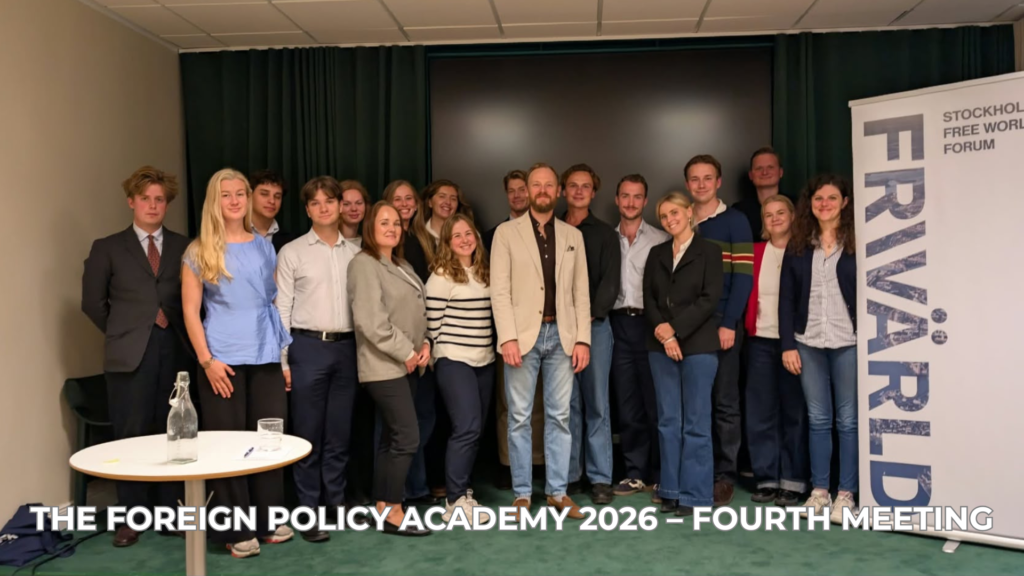
On 5 September, the fourth session of the 2026 Foreign Affairs Academy was held. Now in its second decade, this year-long program offers advanced training and networking opportunities for future experts and decision-makers in foreign and security policy.
The fourth session, themed around challenges to free trade and great power politics, took place at Frivärld’s offices on Kungsgatan in Stockholm. The talks centered on the growing influence of the BRICS countries, the history of trade policy, and China’s role in the world.
Åsa Malmström Rognes, associate senior research fellow at the Asia Programme of the Swedish Institute of International Affairs (UI), opened the day with the session “Taking the Temperature: BRICS – How the West and Europe Are Affected”, on how cooperation among the BRICS countries is developing and what it means for Europe and the Western world order.
The morning continued with a guided tour of the Jewish Museum in Stockholm’s Old Town.
Rikard Westerberg, economic historian and director of the Center for Statecraft and Strategic Communication at the Stockholm School of Economics, spoke under the heading “Trade Policy and History”, placing today’s trade conflicts in a historical perspective, with a focus on the relationship between business and the state.
The day concluded with Björn Jerdén, director of the Swedish National China Centre, who spoke about China’s role in the world and the country’s ambitions in an increasingly polarised global order.
Frivärld’s director, Anna Rennéus Guthrie, is the principal of the Foreign Affairs Academy. Read more about this year’s Foreign Affairs Academy here.