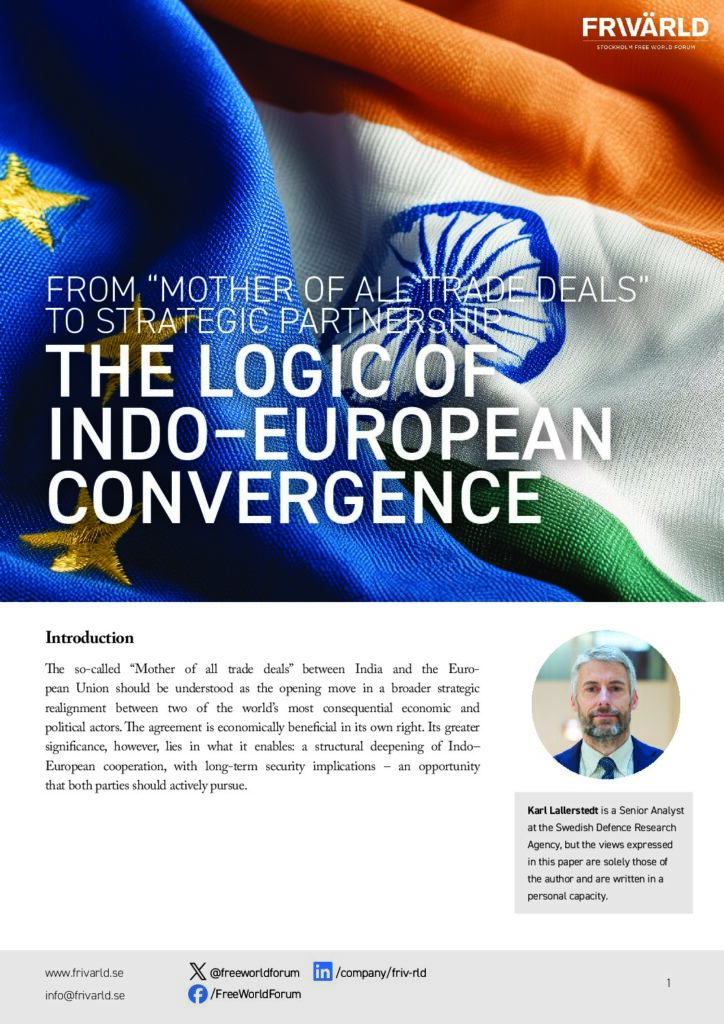
The January 2026 EU–India summit produced both a long-awaited free trade agreement, dubbed the “Mother of all Trade Deals”, and the first comprehensive Security and Defence Partnership between the two sides. Together they mark a genuine strategic inflection point and the opening move in a broader realignment between two of the world’s most consequential pluralistic powers.
In this report, Karl Lallerstedt, senior analyst at FOI by day but writing in a personal capacity, sets out the logic of Indo–European convergence and argues that both sides should actively pursue the security opportunity the agreement enables. Some of the report’s key points are:
- Economic exchange as a security asset: Interdependence shapes strategic behavior. Just as Taiwan’s “silicon shield” raises the cost of non-intervention for the United States, growing economic exposure between the EU and India would make diplomatic, regulatory, and sanction-based support for one another less unthinkable over time — while diversification itself reduces vulnerability to coercion by any single partner.
- Deeper affinities beyond trade and security: Durable partnerships rest on more than economic and security logic. The EU and India are both large, internally diverse systems that govern through institutionalised pluralism and negotiation, in sharp contrast to the centralized models of China and Russia. Shared exposure to terrorism and hybrid threats, and a common interest in resisting a Eurasian order dominated by a single power, reinforce the alignment.
- Obstacles that are real but manageable: Concerns over India’s reliance on Russia, European resolve in a China crisis, and democratic backsliding are often overstated. The EU’s twenty sanctions packages against Russia demonstrate a willingness to absorb significant economic cost. India’s Russia ties are not as simple as often made out, and compromises such as the CBAM arrangement show that frictions can be negotiated.