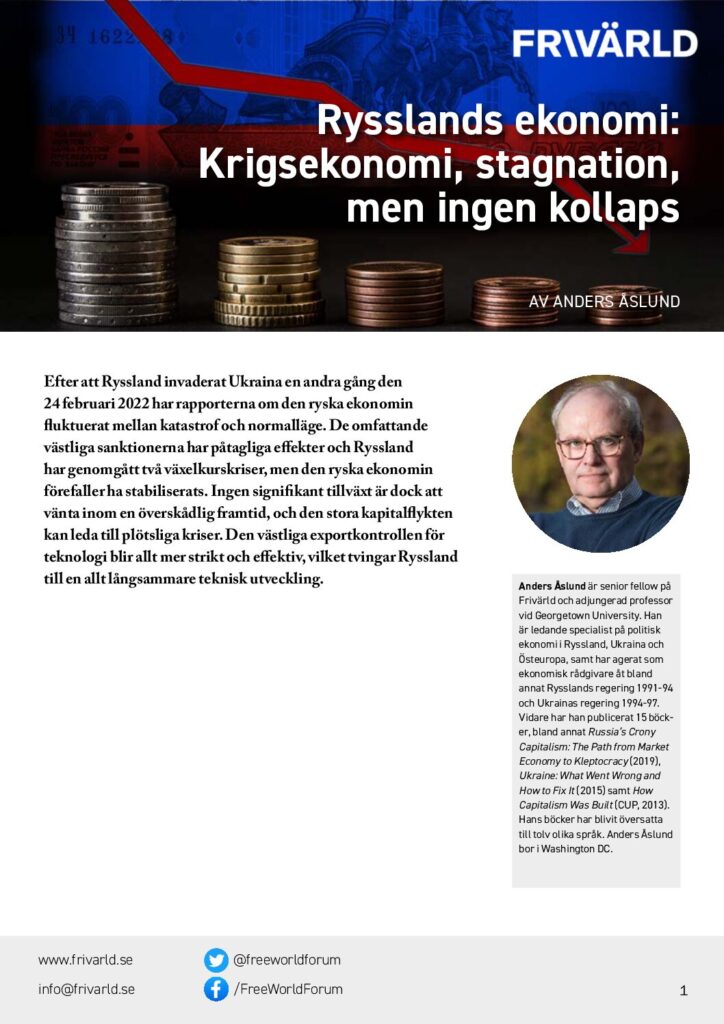
Russia’s Economy: Wartime Economy, Stagnation, but No Collapse

By Anders Åslund
Published 17 September, 2024

How is Russia faring overall, how resilient is the Russian state, and more specifically, what is the state of its economy? In the report Russia’s Economy: Wartime Economy, Stagnation, but No Collapse, author Anders Åslund analyzes the current state of Russia’s economy based on a range of economic factors. Åslund observes that the sanctions imposed by the West following Russia’s full-scale invasion of Ukraine on February 24, 2022, have had a significant adverse impact on the country’s economy. Alongside the war, Russia has experienced substantial capital flight and currency crises, and its economy has now shifted towards a wartime economy, with a negative growth outlook. Taken together, these factors have contributed to an increasingly uncertain future for the country’s economy.

Despite these setbacks, Åslund argues that there are areas where the West could do more to weaken Russia’s economy and, consequently, its war capabilities. Åslund for example recommends that the West substantially raises import tariffs on all Russian goods; confiscates the frozen reserves of Russia’s central bank held in Europe; prohibits Western banks from operating in Russia; re-establishes the Coordinating Committee for Multilateral Export Controls to regulate and prevent export of high-technology goods to Russia; to a larger extent imposes fines on Western companies that continue to pay taxes in Russia; and implements secondary sanctions against sanctions violators in third countries.

Do note that this report is in Swedish.

Dr. Anders Åslund is a senior fellow at the Stockholm Free World Forum and an Adjunct Professor at Georgetown University. He is chairman of the international advisory council of CASE. He is a leading specialist on economic policy in Russia, Ukraine and Eastern Europe. He served as an economic advisor to the Russian government (1991-4) and the Ukrainian government (1994-7). He was a professor at the Stockholm School of Economics and the founding director of the Stockholm Institute of Transition Economics. He has worked at five Washington think tanks – the Atlantic Council, the Peterson Institute for International Economics, the Carnegie Endowment for International Peace, the Brookings Institution, and the Kennan Institute for Advanced Russian Studies. He earned his D.Phil. from Oxford University.

Dr. Åslund is the author of 16 books and the editor of another 16, including Russia’s Crony Capitalism: The Path from Market Economy to Kleptocracy (Yale University Press, 2019); How Capitalism Was Built: The Transformation of the Central and Eastern Europe, Russia, the Caucasus and Central Asia (Cambridge University Press, 2007, 2013), Ukraine: What Went Wrong and How to Fix It (Peterson Institute, 2015); How Russia Became a Market Economy (Brookings, 1995); Gorbachev’s Struggle for Economic Reform (Cornell University Press, 1989). He has also edited sixteen books. He has also published widely, including in Foreign Affairs, The New York Times, The Washington Post, Financial Times, and The Wall Street Journal.