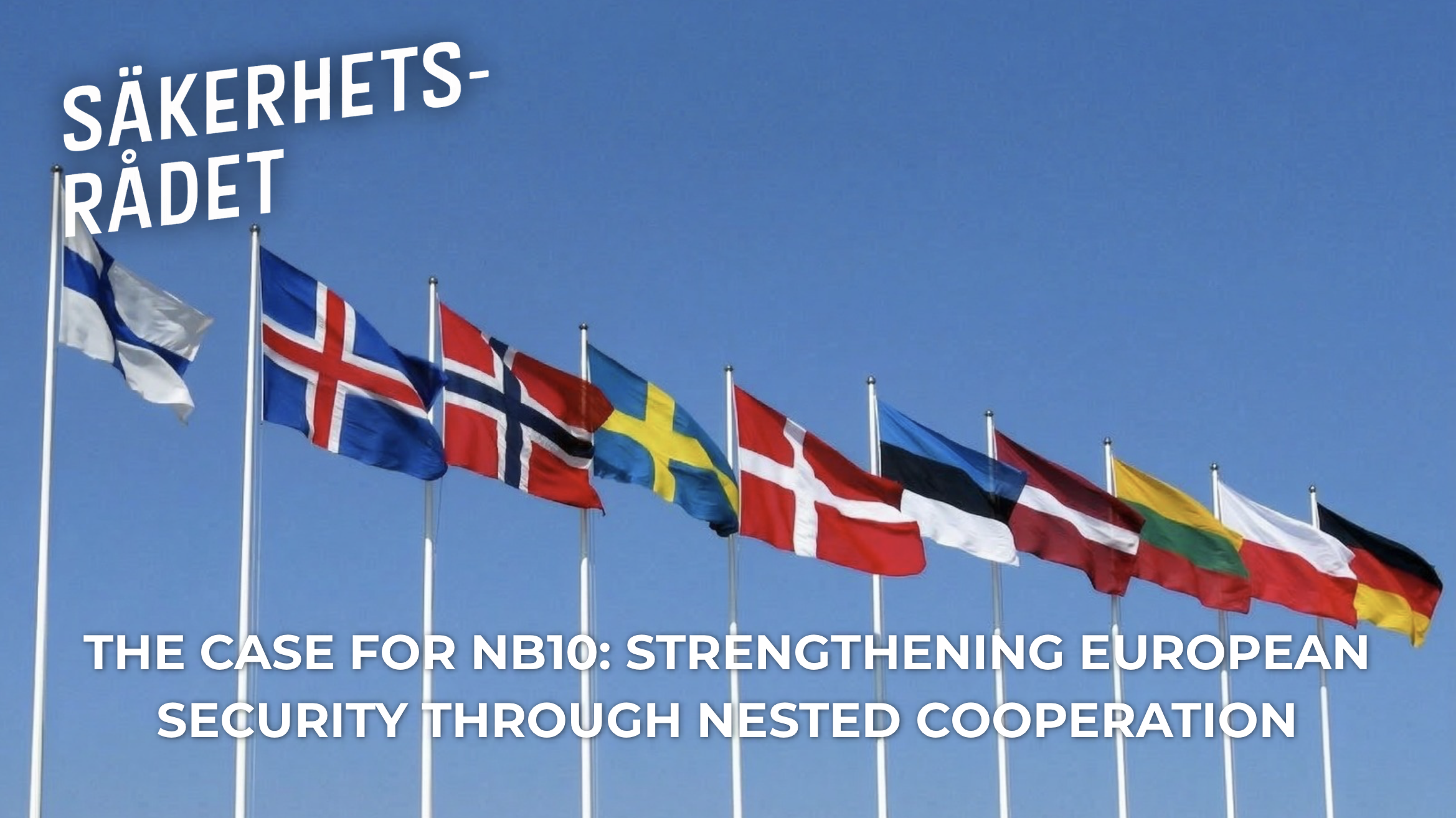
 The NB10 flags / Hansjorn with edits by Frivärld
This brief outlines a strategic approach to deepening defence and security cooperation within a framework called NB10; Nordic Five, Baltic Three, Poland, and Germany. The core idea is to develop flexible, nested formats of cooperation that reinforce, rather than compete with, larger institutions such as NATO and European Union.
This briefing document by the Stockholm Free World Forum (Frivärld) interrogates the strategic necessity of the NB10 format. It specifically examines the framework’s ability to deliver decisive coordination beyond existing NATO, EU, and Joint Expeditionary Force (JEF) structures, while firmly anchoring German engagement in the Baltic Sea region.
The strategic logic of the NB10 format rests on shared values and a common threat assessment, primarily driven by the imminent threat posed by Russia to European security and the critical imperative of ensuring Ukraine succeeds. These countries also share views on China’s role as a strategic enabler for Russia, coupled with its broader hegemonic ambitions. Furthermore, the NB10 nations collectively hold a strong position to handle ongoing concerns regarding political developments within the United States.
A Logic of Concentric Circles
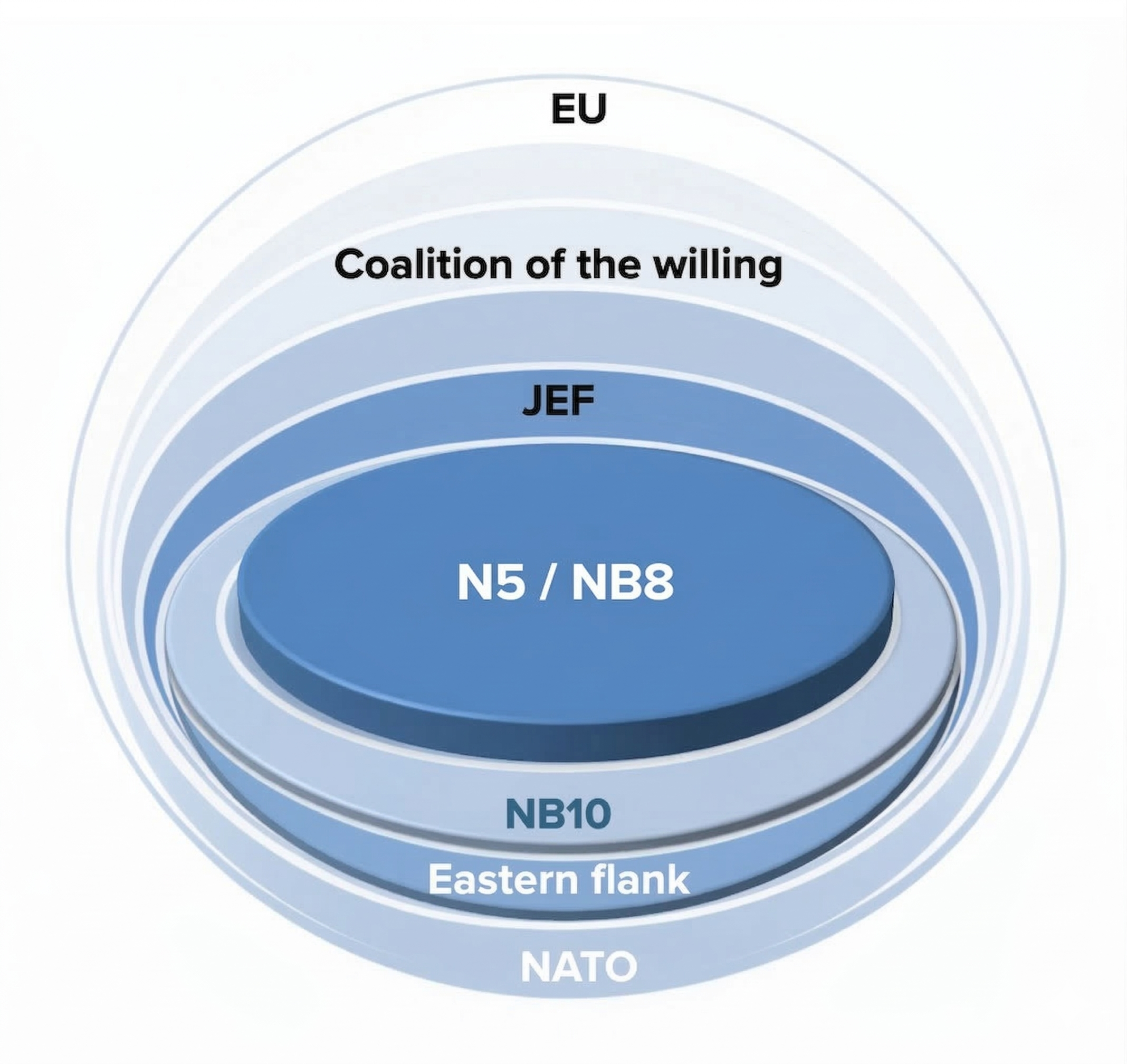
From a Swedish perspective, security cooperation can be understood as a set of concentric circles, where depth, history, geography and operational integration decrease gradually while political weight and geographic scope increase. That is why it is of a core Swedish interest to uphold a functioning Nato and the EU, as well as defend international law.
- Nordic-Baltic CooperationFISE; Finland-Sweden Core
The Nordic cooperation goes back to 1952, and this core expands into Nordic defence cooperation, increasingly interwoven with the Baltic states, with a focus on regional situational awareness, joint training, resilience, and deterrence. The formats are known as N5 and NB8. The innermost circle is the bilateral Swedish–Finlandnish relationship, which remains Sweden’s deepest and most operationally integrated defence partnership – including war time planning forof evacuations of population over the border.
Nordic and Nordic–Baltic Cooperation
The Nordic cooperation goes back to 1952, and this core expands into Nordic defence cooperation, increasingly interwoven with the Baltic states, with a focus on regional situational awareness, joint training, resilience, and deterrence. The formats are known as N5 and NB8.
- NB10: Nordic–Baltic–Polish–German Framework
The next circle brings together the Nordic countries, the Baltic states, Poland, and Germany. NB10 provides a politically and militarily meaningful bridge between Northern Europe and continental Europe, anchoring Germany and Poland more firmly in Baltic Sea and High North security. With this format, all democratic states that shares a coast in the Baltic are joined with the Arctic countries of Norway and Iceland. - Joint Expeditionary Force (JEF)
Above NB10 sits the Joint Expeditionary Force, which includes the Nordic and Baltic states alongside the UK and the Netherlands. JEF offers high readiness, flexibility, and rapid political decision-making below the NATO threshold, demonstrated in the Baltic Sea in regards to cable cutting. It also anchors the Nuclear power UK firmly in the region. - Eastern flank
This format gathers 8 states on the Eastern flank, beside Sweden also Finland, Estonia, Latvia, Lithuania, Poland, Romania and Bulgaria. These states held a summit in Helsinki in December calling for urgent and coordinated action. - Coalitions of the Willing
Further circles consist of ad hoc coalitions formed around specific missions or challenges. These may include NATO allies such as Canada, as well as close partners outside both the EU and NATO. It can be military, or non military, cooperation. - EU and NATO
The outer circles are the EU and NATO, which remain the indispensable frameworks for collective defence, deterrence, and long-term strategic cohesion.
Why NB10 Matters
NB10 matters because it brings together countries that:
- largely agree on the nature of the Russian threat,
- are directly exposed geographically,
- are willing to invest politically and militarily, and
- often move faster together than in larger forums.
For Sweden, NB10 is particularly interesting as a way to anchor Germany more firmly in Northern European security, while also strengthening ties with Poland and reinforcing Nordic-Baltic coherence. This is not about institutionalisation for its own sake. It is about coordination, predictability, and shared ownership of regional security.
NB10 should not be seen as an alternative to existing structures, but as a force multiplier and a trust building format. It enables faster coordination among like-minded states, deeper regional ownership of deterrence and defence, stronger integration of Germany and Poland into Northern European security, and tangible contributions to NATO and EU effectiveness. It could also be a powerhouse of flexible and pragmatic cooperation in supporting Ukraine, build capabilities and deter Russia both conventional but also hybrid by acting more offensive in the hybrid arena.
Three Pillars for NB10 Cooperation
In an era of sustained Russian aggression and growing strategic uncertainty with Trump´s craving for sovereign allied territory in Greenland combined with the Chinese approach of economical dependency the democracies of the High North stand at a dangerous crossroad in history. United we stand, divided we fall.
To get through this era of disruption and shattered continental shells Europe requires both strong institutions and agile cooperation formats. A nested approach, starting with close bilateral ties and expanding through Nordic, Nordic-Baltic, and NB10 cooperation, allows Sweden and its partners to enhance deterrence, resilience, and political cohesion to act swiftly while keeping NATO and the EU at the centre of European security.
To achieve these goals, we suggest three pillars for NB10 moving forward.
Pillar One: Strategic Alignment & Global Communication
- More regular NB10 political–military consultations: Creating cohesion, without cumbersome structures, that focuses on alignment rather than declarations. NB10 should move beyond ad hoc consultations and be institutionalised as a regular political–military dialogue at ministerial and senior official level, with a light-weight structure focused on coordination rather than bureaucracy.
- Coordinated global strategic communication: Moscow, Beijing and increasingly Washington, are conducting information warfare against democracies in Europe. In order to defend ourselves we need to cooperate for global reach. This needs cooperation and strategies on how to make an impact, and this needs to be developed hastily.
- Offensive Information Operations: Establish a Joint Hybrid Response Cell. This would not just mitigate disinformation but actively inflict costs on aggressors in the information domain.
- Global Reach Strategy: Develop a specific sub-pillar for engaging the “Global South” to counter Russian and Chinese narratives, ensuring the NB10 perspective is heard beyond the Euro-Atlantic bubble.
Pillar Two: Functional Integration & Regional Deterrence
- Develop NB10-Led Regional Deterrence Initiatives
Participating states should identify concrete areas, such as Baltic Sea security, air and missile defence, and military mobility and hybrid defense and offense. NB10 can deliver joint planning, exercises, and capability development that feed directly into NATO defence plans, but also act outside of NATO as a coalition of the willing. - Ensure Strategic Coherence with NATO and the EU
NB10 initiatives should be designed to strengthen NATO deterrence and EU security policy, avoiding duplication and ensuring political legitimacy across the wider Euro-Atlantic community. - Anchor Germany and Poland More Firmly in Northern European Security
NB10 should be used as a platform to align German force posture, logistics, and industrial cooperation with Nordic-Baltic and Polish priorities, strengthening Germany’s role as a security provider in the Baltic Sea region.
Pillar Three: Resilient Risk- & Burden Sharing
- Long-term Ukraine Support: Coordinate multi-year defence-industrial contracts for Ukraine. This ensures that even if one member faces “domestic pressure” or “political shifts,” the long-term industrial commitment remains active.
- Internal Cohesion Mechanism: Define a protocol for “Managing Internal Disagreement”. If one member diverges on Russia or China, the other nine must have a pre-agreed “flexible geometry” to continue operations without being paralyzed by a single veto.
- Counter-Coercion Toolbox: Develop shared strategies to reduce economical dependency on China, particularly in critical minerals and tech required for the regional defence industry.
This is an article authored by Frivärld resident senior fellow Patrik Oksanen based on a discussion paper for talks on Nordic and NB10 security interests and cooperation formats.