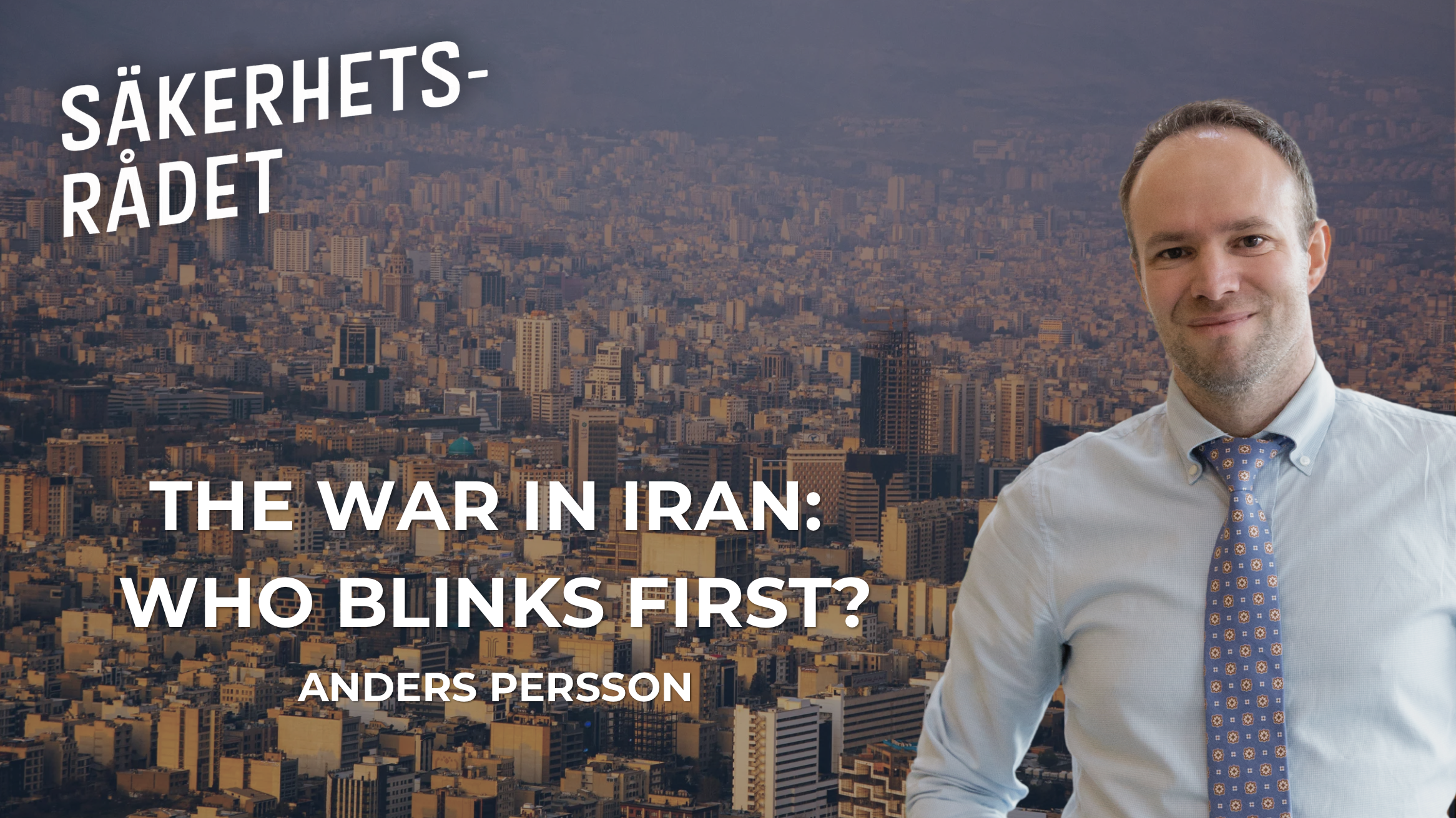
History shows that all wars end, so the question is not if but when, how and on whose terms the war in Iran will be concluded. Are Trumps statements about good and productive talks with Iran the beginning of the end or the end of the beginning? So writes political scientist and Middle East researcher Anders Persson.
The war against Iran has now entered its fourth week. The joint Israeli and American attack against Iran developed into a war already during the first week when the death toll in Iran exceeded 1000 dead, which is the academic threshold for when armed conflicts are to be defined as war. Just as is the case with other contemporary wars, like those in Ukraine and Gaza, the exact death tolls are unclear and the ability of international media to report on the ground in Iran is severely limited.
We therefore live in an information vacuum where it is often difficult to know what is actually happening in real time on the ground in Iran. Unlike the wars in Ukraine and Gaza, the official death tolls so far are remarkably low in all involved countries in the war against Iran with the exception of the situation in Lebanon which has developed into its own war with over 1000 dead there as well. The bombings against Iran, and the retaliation, have been very heavy. No fewer than 15 countries have been subject to bombings of some kind since the attack against Iran began. Therefore it is surprising that the total death tolls on all these fronts, including US losses, are around 2600 at the moment – according to the latest update from Al Jazeera. It is particularly remarkable that the total death toll in the six Arab Gulf countries was 21 in the latest update (March 23, 2026), plus 13 dead Americans. It could also be, as some media reports from Israel have asserted, that Iran is hiding some of its military losses in order not to demoralize the country further.
Despite more than three weeks of intensive fighting, all signs long pointed toward further escalation of the war. The USA threatens to deploy ground forces and to take over Kharg Island which handles 80-90% of Irans oil export. They signal plans to deploy special forces against Irans nuclear facilities to seize the enriched uranium. Furthermore threats to bomb Irans power plants and to by force open the Strait of Hormuz all pointed in the same direction – toward an increased intensification of the conflict. The same logic applied to Irans threats of intensified attacks against energy facilities around the Gulf countries and the countrys latest attack against the American military base Diego Garcia in the Indian Ocean. Observers believe the missile attack occurred with help from either Russia or China since it is located far outside what was previously thought to be the maximum range for Irans missiles. It may be worth noting here that the distance between Iran and Diego Garcia is approximately as large as the distance between Iran and southern Sweden, which means that Iran with its new capacity could reach all the way here with its missiles.
Developments in the war recently and the mutual threats indicated overall that it would get worse before any type of ceasefire or diplomatic agreement would be possible. It also appears that we are heading toward a battle of wills between Donald Trump, Benjamin Netanyahu and the Iranian regime, whose exact rule is unclear. We do not know at this moment which of these three actors will blink first. Trumps cavalcade of threats should be taken with the greatest seriousness since he is the only American president in modern time who has shown himself to be willing to repeatedly use military force against Iran. We also know from research that states escalate in war when they do not reach their previously set goals, which is what Trump appeared to be doing with his repeated threats against Iran and which we have seen Russia do several times before in Ukraine.
At the same time the risk is obvious that the oil price continues to skyrocket and that the worlds stock markets continue to go down if Trump intensifies the war further, for example by striking against the Iranian regimes oil facilities. A key question in the context therefore becomes how high an oil price and how weak stock markets Trump can tolerate before he blinks. Since Trump is a politician with a unique ability to be able to change his mind, the possibility is there all the time that he chooses to end the war instead of intensifying it. On Monday came the first statements from Trump that a diplomatic breakthrough might be possible and that the USA is pushing forward its ultimatum to Iran about bombing its power plants.
Israels Prime Minister Benjamin Netanyahu, who has spent his entire political career warning about the threat from Iran, is not at all as dependent on the wars global effects as Trump is. This means that he partly has a different incentive structure than what Trump has. Netanyahu has Israeli public opinion behind him, but a parliamentary election in October ahead of him. Trump and Netanyahu are however in the same boat in that they in some way need to win the war that they together started. Both Trump and Netanyahu risk their political legacies if the war against Iran does not become successful. By all accounts an enormous betrayal debate also waits within the Republican party in the USA, and probably also against Israel and pro-israeli organizations in the USA, if the war does not become successful.
For the Iranian regime the war is even more existential than it is for Trump and Netanyahu since it is a direct threat against the regimes survival. Therefore the Iranian regime also needs some form of victory in the war to somewhat secure its survival. An unconditional ceasefire would at the moment probably be regarded as very negative from the Iranian regimes point of view. This because a ceasefire would leave the country in ruins, under continued sanctions, with limited possibilities for reconstruction and at the same time wide open for future American and Israeli attacks. The Iranian regime needs either to by military means deter the USA and Israel from future attacks, or a strong diplomatic agreement backed by guarantees from Russia and China to feel safe from future American and Israeli attacks. Another alternative would be to develop nuclear weapons.
History shows however that all wars end, so the question is not if, but when, how and on whose terms the war against Iran will be concluded. In war and armed conflicts it is the job of international diplomats to find what in research is called ripe moments. Where all sides can either feel like they won something or where they have suffered so much that they prefer a negotiated solution before continued fighting.
If Trump truly has had a breakthrough in the talks with Iran, despite Iran at the moment denying this, and if the Iranian regime weathers the war and in some way concludes a ceasefire with the USA and Israel, a nearly perverse situation could arise in the future. If the Iranian people once again were to choose to rise up against a regime that in the name of peace was given support and legitimacy by the international community – whose side should liberals and other democratic forces then take?
Anders Persson is an associate professor in political science and Middle East researcher at Linnaeus University in Växjö. Follow him on X/Twitter: 82anderspersson