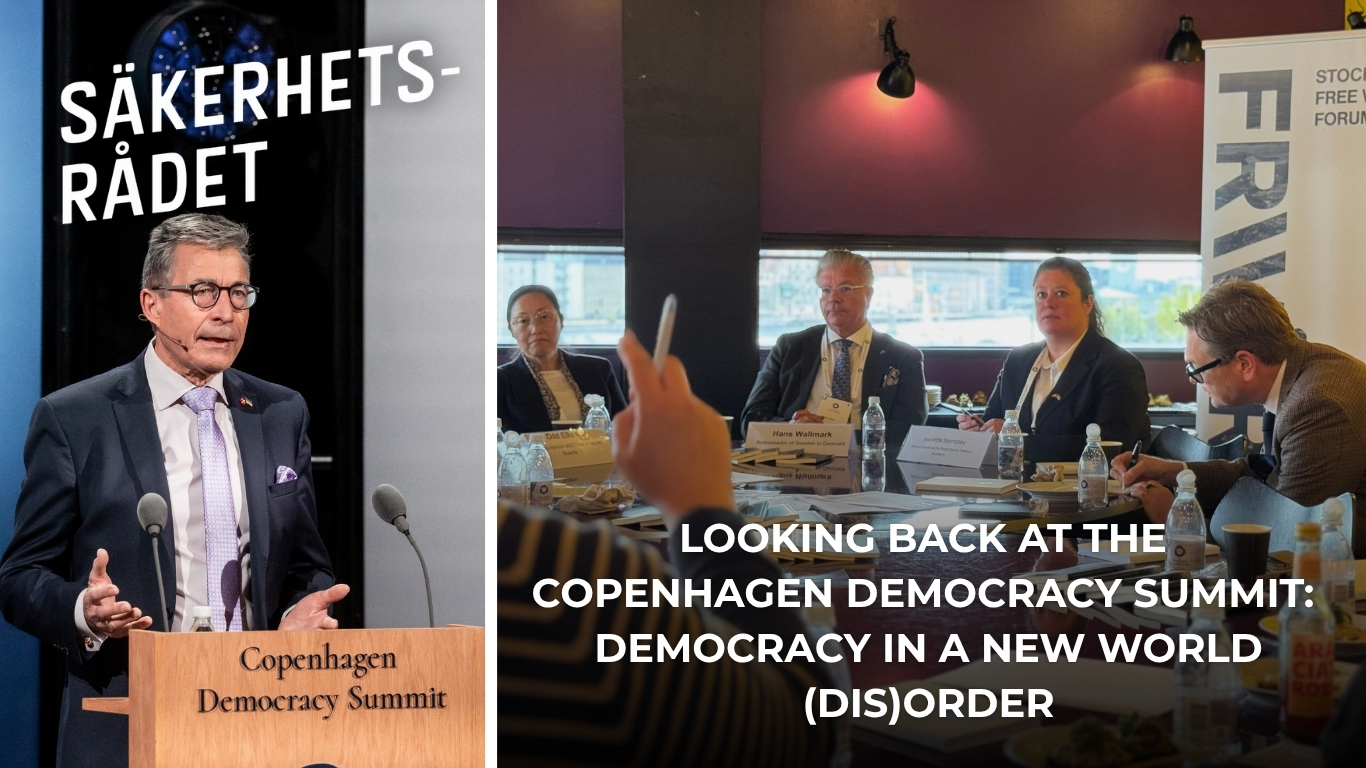
Recently, Stockholm Free World Forum attended and hosted a roundtable at the Alliance of Democracies 2026 Summit in Copenhagen. Themed ‘Building an Alliance of Democracies in a New World (dis)Order’, this year’s summit repeated the tradition of bringing together leading regional and global actors in international affairs, presenting a unique opportunity for the Nordics to demonstrate its role as a champion of democratic values and institutions. Led by Anders Fogh Rasmussen, featured speakers included John Bolton, Chrystia Freeland, and Francis Fukuyama, among many others.
The Nordic Moment
The summit provided Stockholm Free World Forum with an opportunity to bring a central pillar of its research agenda to the table. In recent years, the role of the Nordic region has been covered in various reports and forums, spanning questions of, for instance, solidarity, leadership, and strategic identity.
Accordingly, Stockholm Free World Forum convened its roundtable under the title ‘In the Nordics We Trust: Trust as a Regional Asset and Recipe for Resilience and Unity.’ Moderated by the Director of Stockholm Free World Forum’s Director, Anna Rennéus Guthrie, the panel featured:
- Odd Eiken – Former Undersecretary of State in the Swedish government, and VP at Skandia and SEB
- Tove Lifvendahl – Political Editor-in-Chief of Svenska Dagbladet
- Hans Wallmark – Swedish Ambassador to Denmark
- Jeanette Serritzlev – Military Analyst at the Royal Danish Defence Academy
The discussion surfaced promising ideas for deepened Nordic cooperation. A shared ambition to lower barriers to exchange emerged across several themes, such as promoting the use of Nordic languages in regional work, reducing economic bureaucracy between Nordic countries, and expanding knowledge sharing across borders.
Above all, the conversation was anchored in what appeared as the broader sentiment of the summit – a Nordic geopolitical moment. The opening hour, including remarks by, and conversations with, Jens-Frederik Nielsen and Mette Fredriksen, the Prime Minister of Greenland and Denmark respectively, gravitated the summit towards the pressure facing the Kingdom of Denmark and its partners.
Critically, the transatlantic relationship, once a beacon for democratic values, has now become the fault line along which those values are tested. Following renewed US assertiveness over Greenland, the Nordic Moment – discussed by Stockholm Free World Forum’s Chairman, Gunnar Hökmark, at the Nordic Council in 2025 – has in 2026 turned from idea to a proven model for defending that very fault line.
The summit’s attention, however, was primarily at the Ukrainian front line. Drawing a longer historical trajectory, Jonas Parello-Plesner, Director of the Alliance of Democracies, bridged Danish lessons of the past with today’s disorder. By republishing Hal Koch’s ‘What is Democracy?’ (first published upon Denmark’s liberation in 1945) in a Ukrainian edition, a powerful precedent was presented, highlighting what the fight for democracy can yield.
The D7
In light of the evolving geopolitical reality, the summit also served as a platform for Anders Fogh Rasmussen to unveil a proposal for a new international forum for democratic nations. Under the banner ‘Democracies-7’, or ‘D7’, the new initiative would gather the EU member states, the UK, Canada, Australia, New Zealand, Japan, and South Korea, in an economic ‘Coalition of the Willing’, grounded in shared democratic principles.
The core principles for what the coalition would be and do include:
- Democratic trade alliance
- Economic Article 5
- Joint investments in the Global South
- Democratic ‘supply chain’ of critical raw materials
- Technology cooperation
- Deepened defence cooperation
The first two measures capture much of the essence of the D7 coalition. Being a ‘Democratic Trade Alliance’ speaks to the D7’s function of defending free trade and serving as a counterweight to a weakened WTO.
The enforcement of the first measure appears to rest in the deterrence of the second. An Economic article 5 suggests modelling NATO’s collective defence clause, so that the D7 members would respond jointly to any economic coercion targeted at a member. As the D7 represent 30% of global GDP, the grouping is believed to carry significant economic weight, providing democratic nations with a credible instrument of collective leverage against coercive actors.
A New World (dis)Order
In recent years, the upheaval of the liberal world order has seen actors repositioning themselves in what remains a highly fluid landscape. The D7 seems like an initiative which could breathe life into a fragmenting system, while at the same time acknowledging its vulnerabilities.
Fundamentally, however, the D7 would formalise what other actors have already aligned around, that is replacing trust in international institutions to leveraging economic might as means to maintain stability.
Clearly, deterrence is the new black – and the D7 is no exception to the trend.
As such, the initiative flirts with a world order structured in accordance with Alexander Stubb’s ‘Values Based Realism’. Some elements do, however, stop it short of fully breaking with the old order.
One such element is the D7’s member structure, which resembles a kind of last bastion of the old order. While ‘joint investments in the Global South’ is mentioned, reforms for the emerging order should be cautious about excluding actors and regions which will have an ever growing influence in the 21st century.
Indeed, this question – of inclusion and exclusion – appears to be a hot potato for Fogh Rasmussen. When the exclusion of the US was raised, the door was left open, but contingent on a US administration with aligned interests. In fact, any nation with democratic principles was a potential member.
To avert a revolving door situation, the membership criteria warrant further consideration before any launch of a D7 or WTO 2.0.
Fundamentally, however, the D7 initiative captured the summit’s shared sentiment around avoiding building dependencies with actors which do not share democratic values. Russia showed the risks of choosing interest over values – costs that continue to accumulate.
Leaving Copenhagen
Looking back at the summit, trust stood out as a powerful lens for debating the health of democracy. It has indeed proven a major strategic asset for the Nordics, yet a costly vulnerability for Europe when misplaced.
Moving forward, trust is being reoriented. Shared values appear less like a diplomatic nicety and more like a prerequisite for it. In a world reordering around might and competing models of governance, the ability of democracies to hold together may be their most powerful deterrence.