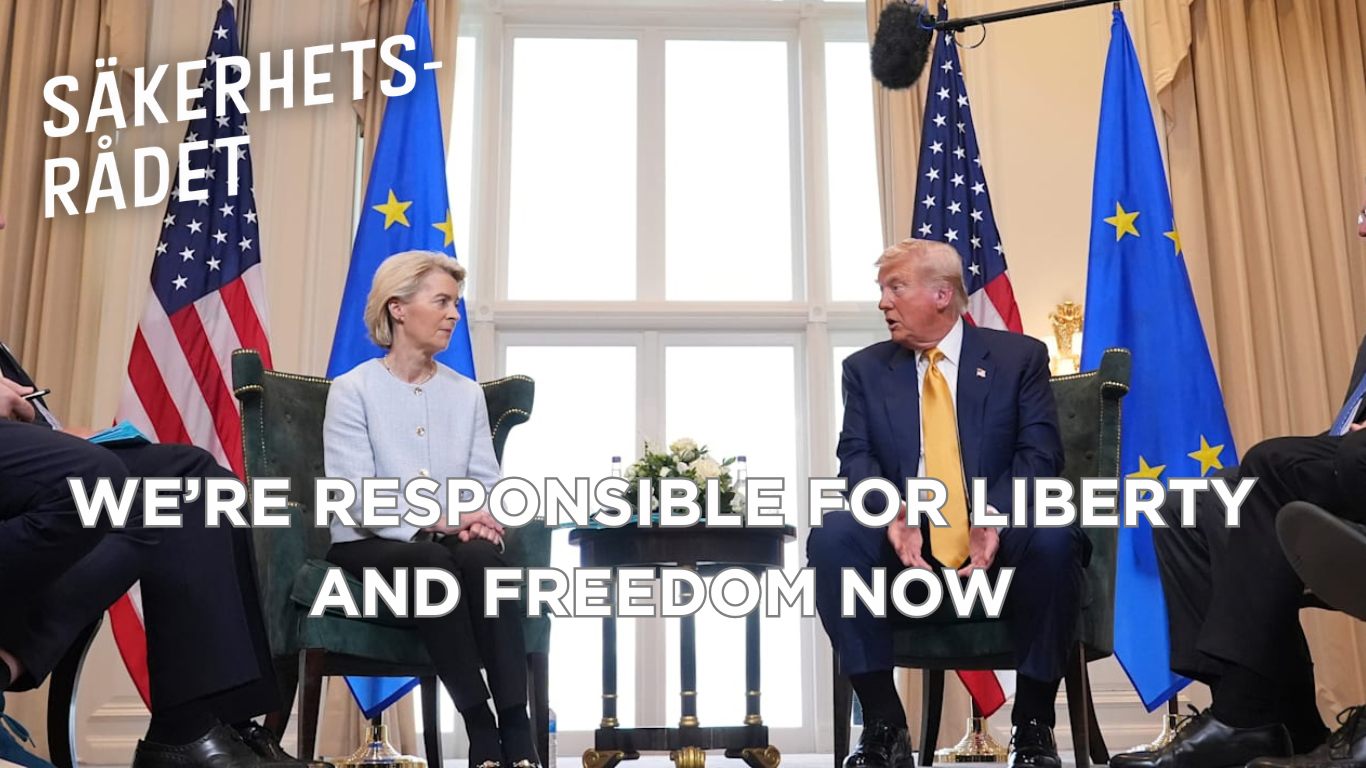
Ursula von der Leyen and Donald Trump (Jacquelyn Martin / AP)
With an intense and disruptive year in geopolitics behind us, the outlook for 2026 is unfortunately not bright. We find ourselves in a time where things are falling apart. It has taken some time to realize this, which is natural when trauma is involved. And trauma is what best describes what was initially an averted gaze and is now a more aggressive actor. Yes, we are talking about a United States that is breaking up with Europe and acting as if “ally” implies nothing; where claims on Greenland are spiced with the suggestion that military means cannot be ruled out.
We must not lose hope that the pieces can one day be put back together, even if, in time, things often work out that way. But that does not diminish the gravity of the fact that we are now in a phase where, precisely because of this transatlantic decoupling, we require a great deal of urgent reforms to stabilize the situation. We can no longer seek stability and freedom from others. We are responsible for upholding our own freedom and stability now.
As Ukraine has soon been subjected to four years of war, the defense of its future is complicated with the US switching tracks – from constructive and unifying leadership to high-octane echoing of Russia’s will and ambitions. Beyond voting with, rather than against, the authoritarian country in the east at the UN, the US also decided to write Europe and the EU into its national security strategy as an entity to work towards dissolving. Since then, the US has also set about taking control of the dictatorship in Venezuela and bringing the sitting leader of that dictatorship to the US in a manner that can instill both fear and delight in other authoritarian leaders.
The reasons behind the US’s actions can be debated at length; objections regarding the imperfections of the previous world order or the US’s questionable actions in the past can also be scrutinized. But that is insufficient to explain the current course of events. Furthermore, the principled problems facing Europe remain, regardless of this. We urgently need to have many honest conversations with real friends in the US about all of this. We need to find survival strategies to get through a period of great trials for everyone who believes in liberal society and what, until quite recently, could be described as common Western values.
We also need to, above all, have honest conversations amongst Europeans regarding what the new US is doing to us and our future. Unfortunately, the US’s departure from the liberal world order is yet another complication amidst an already troubling cluster of dictatorships and authoritarian regimes and states seeking to reshape the world order through aggression, violence, and coercion.
China, Russia, and Iran, to name a few states, we have already defined, albeit in varying degrees and forms, as hostile actors. How shall we handle the aggregated total pressure against Europe from adversaries of varying degrees of strength and expression?
We all understand that these are no small matters at stake, but our core circle of peaceful democracies risks – if we linger in passivity – becoming increasingly small, though we could seize this as an opportunity to grow.
Several countries with which Europe has established good relations may become even more important to grow with. Countries around the world, such as Canada, Australia and New Zealand, Japan and South Korea, democracies in South America, and even those dawning in Africa. At the same time, we must dare to quickly open new doors where we know friends are waiting. We cannot afford to put democracies on a waiting list. Here, for example, is Taiwan, which we know and recognize perhaps primarily because it is a nation that irritates China. But they will be that regardless of whether we invite them closer to us in Europe or not.
Even if authoritarian nations ramp up their destructive ambitions, we can choose to act and promote freedom when and where it exists. Freedom is important to defend everywhere, not just next door, unless we want to be forced into a new global world order where democracy becomes the ridiculed and beleaguered exception.
It is we who safeguard freedom and stability now. And that entails a duty.
Anna Rennéus Guthrie Director, Stockholm Free World Forum (Frivärld)