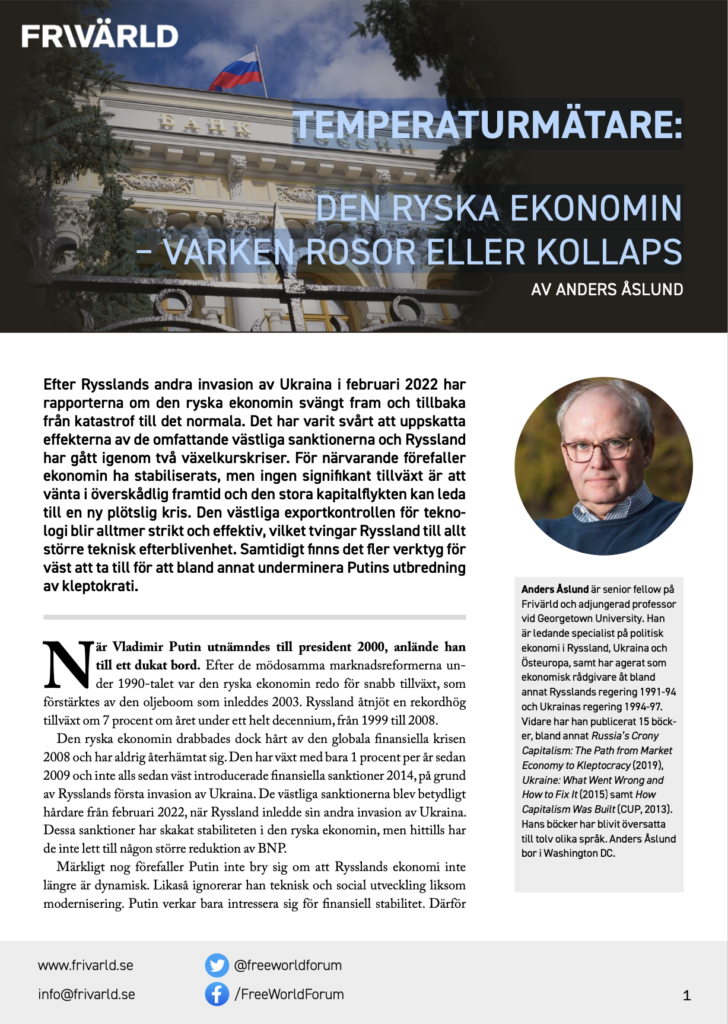
Dr. Anders Åslund is a senior fellow at the Stockholm Free World Forum and an Adjunct Professor at Georgetown University. He is chairman of the international advisory council of CASE. He is a leading specialist on economic policy in Russia, Ukraine and Eastern Europe. He served as an economic advisor to the Russian government (1991-4) and the Ukrainian government (1994-7). He was a professor at the Stockholm School of Economics and the founding director of the Stockholm Institute of Transition Economics. He has worked at five Washington think tanks – the Atlantic Council, the Peterson Institute for International Economics, the Carnegie Endowment for International Peace, the Brookings Institution, and the Kennan Institute for Advanced Russian Studies. He earned his D.Phil. from Oxford University.
Dr. Åslund is the author of 16 books and the editor of another 16, including Russia’s Crony Capitalism: The Path from Market Economy to Kleptocracy (Yale University Press, 2019); How Capitalism Was Built: The Transformation of the Central and Eastern Europe, Russia, the Caucasus and Central Asia (Cambridge University Press, 2007, 2013), Ukraine: What Went Wrong and How to Fix It (Peterson Institute, 2015); How Russia Became a Market Economy (Brookings, 1995); Gorbachev’s Struggle for Economic Reform (Cornell University Press, 1989). He has also edited sixteen books. He has also published widely, including in Foreign Affairs, The New York Times, The Washington Post, Financial Times, and The Wall Street Journal.